Light Amplification Mitigation for Boat Flooring
How AWC Helps Prevent the Same Problem From Happening Again
The Right Marine Flooring Material Comes First
When choosing boat flooring for Florida, one of the biggest considerations is how the material will perform under extreme heat and constant sun exposure.
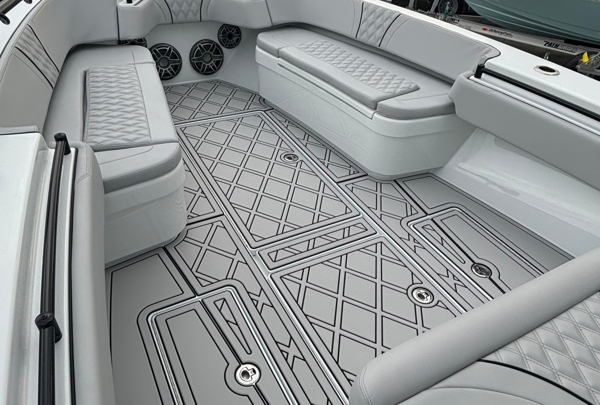
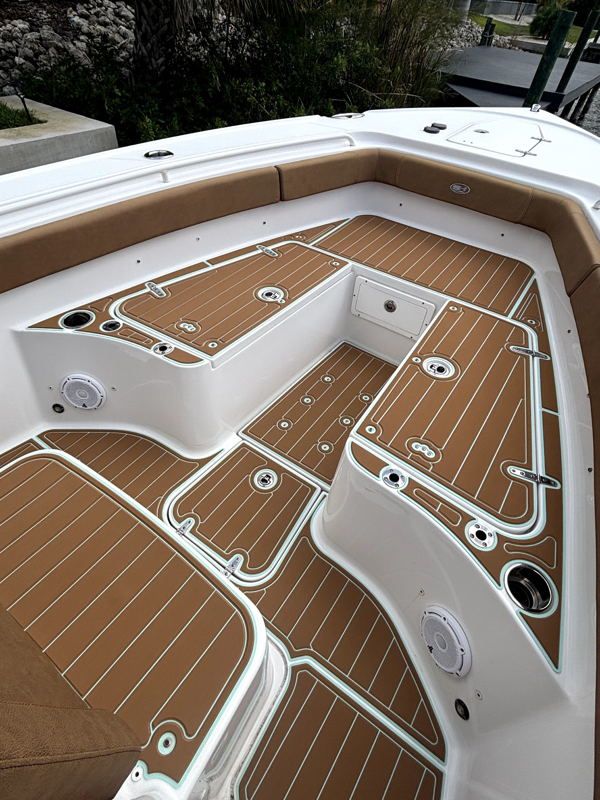
At All Water Customs, we use 100% closed-cell PE foam, selected specifically for its high heat resistance and performance in demanding marine environments. It provides boat owners with a significantly stronger solution than many traditional EVA foam products, which can be more vulnerable to heat-related deterioration.
PE foam is designed to withstand higher temperatures and offers a lower risk of heat-related issues such as light amplification. But as experienced marine flooring professionals know, no flooring material can control the unique design of every boat.
Certain boat models may have specific surfaces, angles, windows or other reflective areas that concentrate heat onto one section of the flooring. This is known as light amplification.
The important difference is that AWC does not simply install flooring and walk away.
For more than 10 years, we have worked in the Florida marine industry and have developed a three-step approach to helping protect our clients' investment:
- Start with premium 100% closed-cell PE foam with exceptional heat resistance.
- Protect the investment with a 5-Year Written Warranty that includes light amplification and adhesive coverage.
- When a problematic area is identified, use mitigation solutions designed to address the root cause and reduce the risk of the replacement piece experiencing the same issue.
Because the goal is not simply to replace a damaged piece.
The goal is to understand why it happened and help prevent it from happening again.
What Is Light Amplification on Boat Flooring?
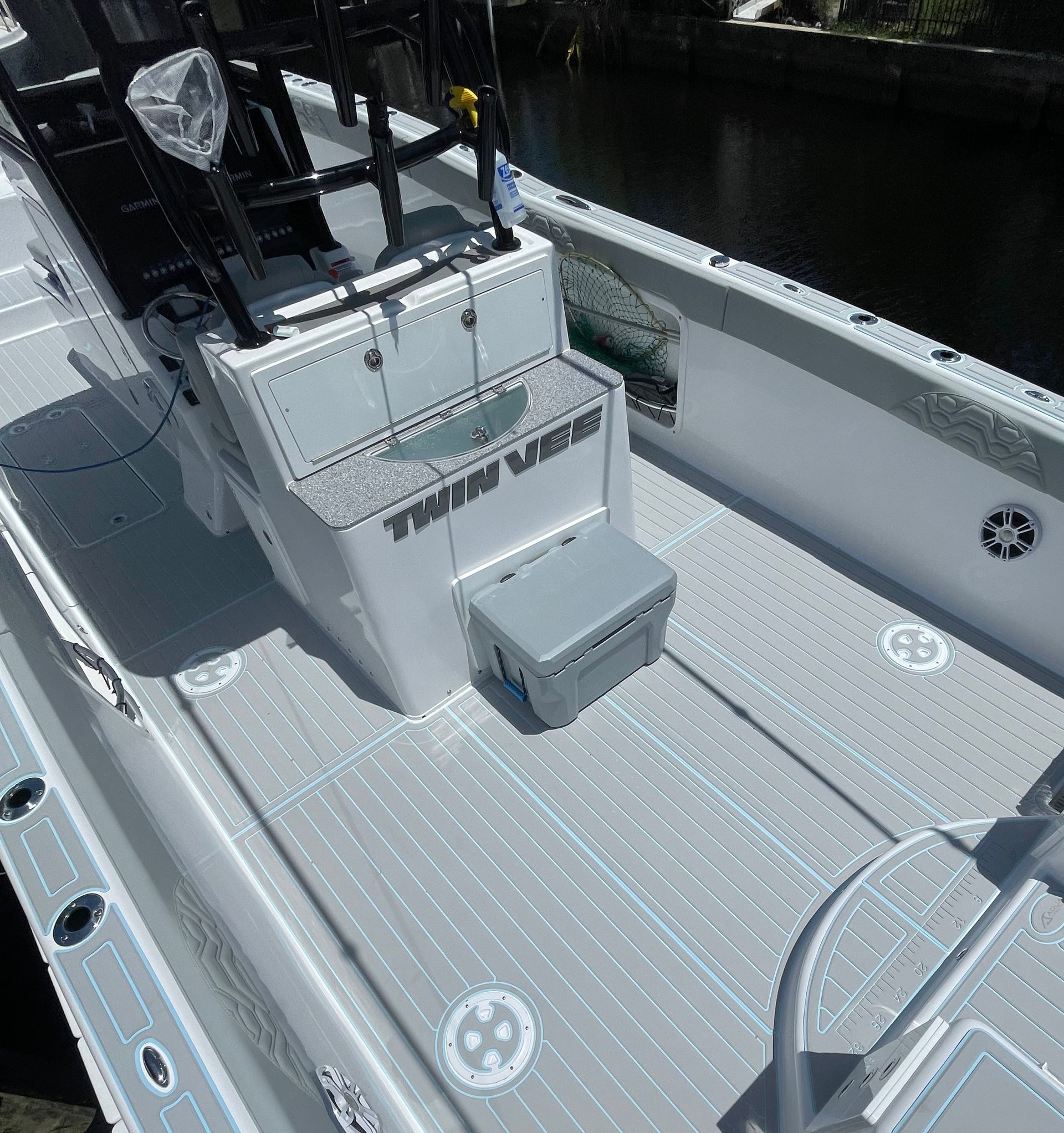
Light amplification occurs when sunlight and heat are intensified by reflection from surrounding surfaces. A specific area of a boat may receive significantly more heat than the rest of the deck due to reflected sunlight from surfaces such as:
- White gel coat
- Consoles
- Windows
- Windshields
- Stainless steel
- Nearby structures
- Highly reflective surfaces
The result is a concentrated area of heat that can be significantly more aggressive than normal direct sun exposure. This is why one small section of a boat floor may experience an issue while the surrounding flooring continues to perform normally.
The Installation Is Not Always the Problem
When flooring experiences repeated problems in the exact same location, the first instinct is often to assume there was an installation problem.
In many cases, however, the environmental conditions affecting that specific area are the real issue. It is extremely rare for this type of damage to be from an installation.
If intense heat is absorbed or sunlight continues to reflect onto the same location every day, replacing the flooring with another piece—without addressing the concentrated heat source—may simply result in the same problem occurring again.
Replacing the piece is one step. Understanding why it happened is the next.
Why AWC Does Not Use EVA Foam
AWC frequently sees and replaces older EVA foam flooring that has struggled in Florida's extreme heat and marine environment.
EVA foam is widely available and commonly used in lower-cost marine flooring. While it may initially look good, material performance can vary significantly depending on the quality of the foam and the conditions the boat experiences.
AWC does not use EVA foam for our primary marine flooring product.
Instead, we use 100% closed-cell PE foam selected for its higher heat resistance, durability, stain resistance, and marine performance.
Our goal has always been to provide our clients with a stronger foundation from the beginning.
Learn more about the difference between PE and EVA foam:
PE Foam vs. EVA Foam for Boat Decking in Florida
PE foam provides significantly greater resistance to heat-related issues than many lower-performing foam products.
However, AWC also understands something important:
No material can change the conditions surrounding the boat.
Certain boat models and specific areas of a boat can experience unusually intense reflected heat. In those cases, even a higher-performing material may benefit from additional protection.
The Best Solution Isn't Always Just Replacing the Flooring
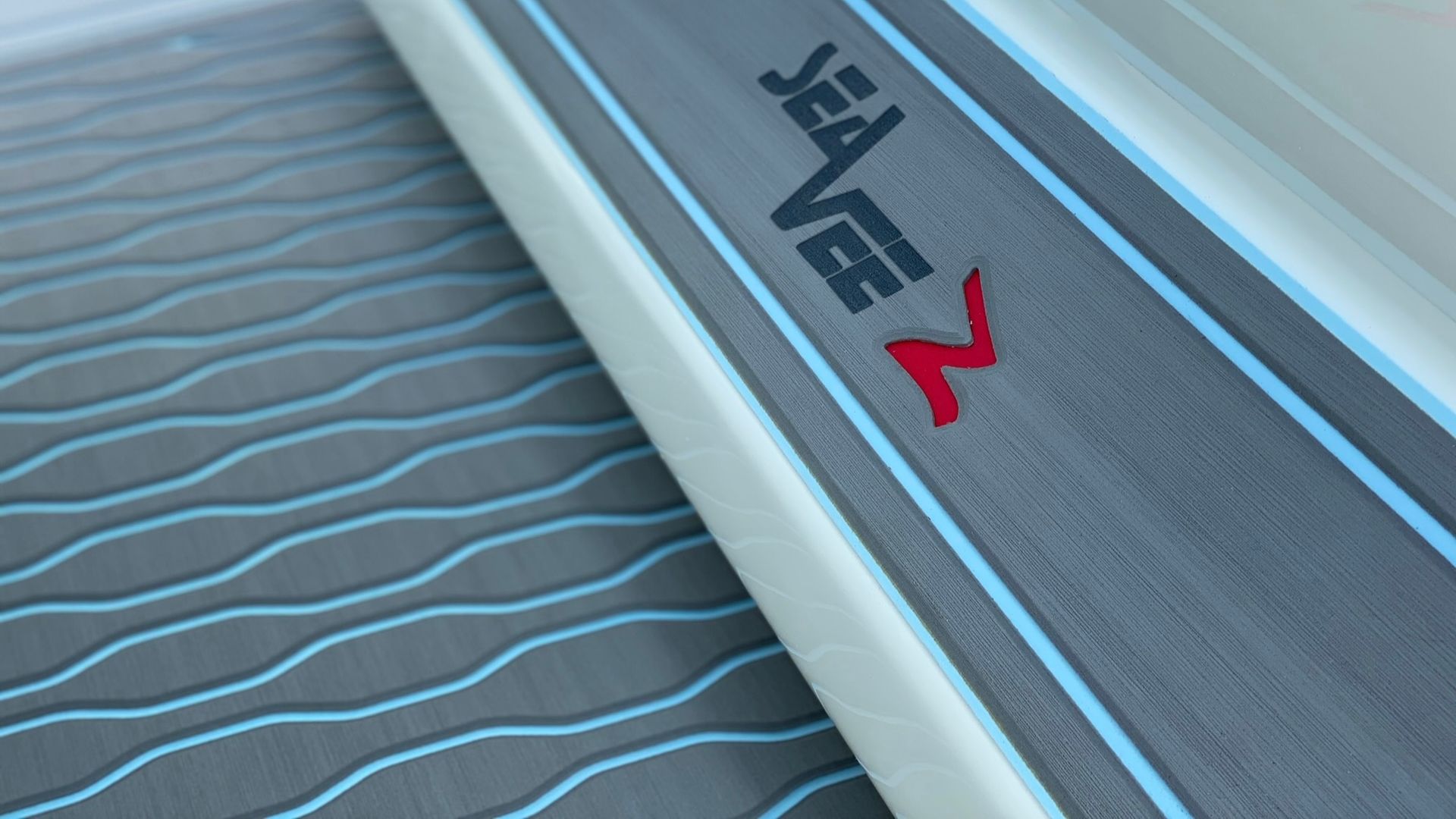
You need to address the root cause.
Our First Step: Start With a Better Product
Before discussing mitigation, the most important step is selecting the right material.
AWC's flooring is:
✔
100% Closed-Cell PE Foam
✔
100% Stain Resistant
✔ Designed with
high heat thresholds
✔ Comfortable underfoot
✔ Non-slip
✔ Easy to clean
✔ Designed for demanding marine environments
We don't believe the solution to a heat problem should be to start with a lower-performing material and hope a warranty will cover it later.
We start with the strongest product we can provide.
Our Second Step: Protect Your Investment With a Real Warranty
Light amplification is one of the biggest concerns boat owners should consider when purchasing marine flooring.
That's why AWC offers a 5-Year Written Warranty that includes Light Amplification and Adhesive coverage.
These are important areas of coverage because heat and environmental conditions can affect flooring differently from one boat to another.
Our goal is simple:
If a covered issue occurs, your investment is protected.
But warranty replacement is only one part of the solution.
Because if the replacement piece goes back into the exact same high-intensity environment, we want to consider what can be done to reduce the likelihood of the issue happening again.
What Other Company’s Warranty
Many marine flooring companies offer warranties ranging from one to three years. But before choosing a flooring company based on the length of the warranty, boat owners should ask one important question:
What is actually covered?
Heat-related issues such as light amplification and adhesive performance can be among the most important factors affecting marine flooring in hot climates. Yet these issues are not included or not specifically covered under many marine flooring warranties.
AWC is proud to offer a 5-Year Written Warranty that includes coverage for both light amplification and adhesive performance.
This matters because a warranty that sounds impressive on paper may offer very little protection if the issues most likely to impact the flooring are excluded.
Our Third Step: Look for a Solution That Addresses the Root Cause
This is where AWC takes a different approach.
Some companies may simply replace the flooring and leave the client hoping the same issue does not return.
We believe in looking for the reason the issue occurred.
If we identify a specific area where concentrated heat and reflected sunlight continue to create a problem, our team can discuss mitigation options.
One of Those Options Is a Preventative Spray Application.
Our preventative spray system can be applied to problematic areas where additional protection may be beneficial.
For example:
A boat may have one specific location where sunlight consistently reflects off a nearby surface and concentrates intense heat on the same section of flooring.
The rest of the boat may perform perfectly.
In that situation, there may be no reason to treat the entire boat repeatedly.
Instead, the preventative application can be considered for the specific problematic area.
This approach is:
✔ Targeted
✔ Affordable
✔ Simple
✔ Available through AWC
✔ Designed to help mitigate recurring issues in known problem areas
A Replacement Piece Doesn't Have to Repeat the Same Problem
If you experience a covered light amplification issue, AWC may need to recut the affected piece.
But before simply putting a new piece back into the same location, we can evaluate whether mitigation would make sense.
The process may look like this:
STEP 1 — IDENTIFY THE PROBLEM AREA
We review the affected location and surrounding conditions.
STEP 2 — REPLACE THE COVERED PIECE
When applicable under the warranty, the affected piece is recut.
STEP 3 — APPLY MITIGATION WHERE APPROPRIATE
A preventative spray application can be added to the known problematic area. It is an additional cost, but affordable and valuable to preventing the same area from being burned again.
STEP 4 — ADDRESS THE ROOT OF THE PROBLEM
The goal is not just to replace the material. The goal is to help prevent the same environmental condition from affecting the replacement piece.
This is especially useful when there is a
specific, recurring area of concentrated heat.
Why Mitigation Matters
The easiest answer to a recurring flooring problem is simply:
Replace the piece again.
But if the same piece continues to experience the same unusual conditions, replacement alone may not be the best long-term solution.
AWC believes in being proactive.
We are continually evaluating materials, installation methods, warranty issues, and new solutions that can improve long-term performance for our clients.
After more than 10 years in the marine flooring industry, we know that boats are not all the same.
Every boat has different:
- Surface configurations
- Console designs
- Windshields
- Reflective surfaces
- Exposure angles
- Storage environments
- Heat conditions
That is why a one-size-fits-all approach doesn't always work.
Our team looks for solutions based on the specific issue and the specific boat.
The AWC APPROACH TO LIGHT AMPLIFICATION
When you purchase marine flooring, you should consider more than how the material looks on installation day.
You should ask:
What happens if my boat experiences a problem?
At AWC, we believe the answer should include more than, "Buy another floor."
FIRST: Start With a Better Material.
AWC uses 100% Closed-Cell PE Foam with high heat thresholds and strong performance characteristics for demanding marine environments.
SECOND: Protect the Investment.
Our 5-Year Written Warranty includes Light Amplification and Adhesive coverage—two important areas that boat owners should understand when comparing marine flooring options.
THIRD: Look for the Root Cause.
If an issue occurs, we don't want to simply replace the piece and hope for a different result.
When appropriate, we can discuss mitigation options, including targeted preventative spray applications for known problematic areas.
BETTER PRODUCT.
BETTER WARRANTY.
BETTER SOLUTIONS.
At All Water Customs, our job doesn't stop after installation.
We've spent more than a decade learning what works, what fails, and why.
That experience has taught us that the best solution is not always to simply replace a product.
Sometimes the better solution is to understand the conditions affecting the product—and find a way to address them.
BETTER PRODUCT
100% Closed-Cell PE Foam selected for demanding marine conditions.
BETTER PROTECTION
A 5-Year Written Warranty that includes Light Amplification and Adhesive coverage.
BETTER SOLUTIONS
Mitigation tools available to help address recurring issues in specific problem areas.
Your boat is different. Your conditions are different. Your solution should consider that.
EXPERIENCING A PROBLEM AREA ON YOUR BOAT?
If you've experienced a recurring heat or light amplification issue in a specific area of your boat, contact All Water Customs.
Our team can evaluate the situation and discuss the best available options—including replacement and mitigation solutions where appropriate.
Don't just replace the problem. Let's look for the reason it keeps happening.
Contact All Water Customs today.
Serving Florida Boat Owners Since 2016

Susan Werner is a business growth and operations executive with more than 20 years of experience leading sales, marketing, and operational performance initiatives. As VP of Operations at All Water Customs, she oversees revenue growth, digital marketing strategy, customer acquisition, sales infrastructure, business operations, and strategic product development within the marine flooring industry. Susan is recognized for building scalable systems that drive measurable growth while also leading research and development efforts in marine flooring materials, helping introduce higher-performing foam technologies that improve durability, enhance customer satisfaction, and support stronger warranty programs for both boat owners and marine flooring businesses.