How to Choose a Boat Flooring Installer in Florida
KEY TAKEAWAYS
- Ask the boat flooring installer whether they capture your deck with a digitizing tool that produces a CAD file or a hand-held tape measure – the method determines how well the finished floor fits. You should also receive a full approval drawing in color and pattern that is generated from your specific measure, not an existing template.
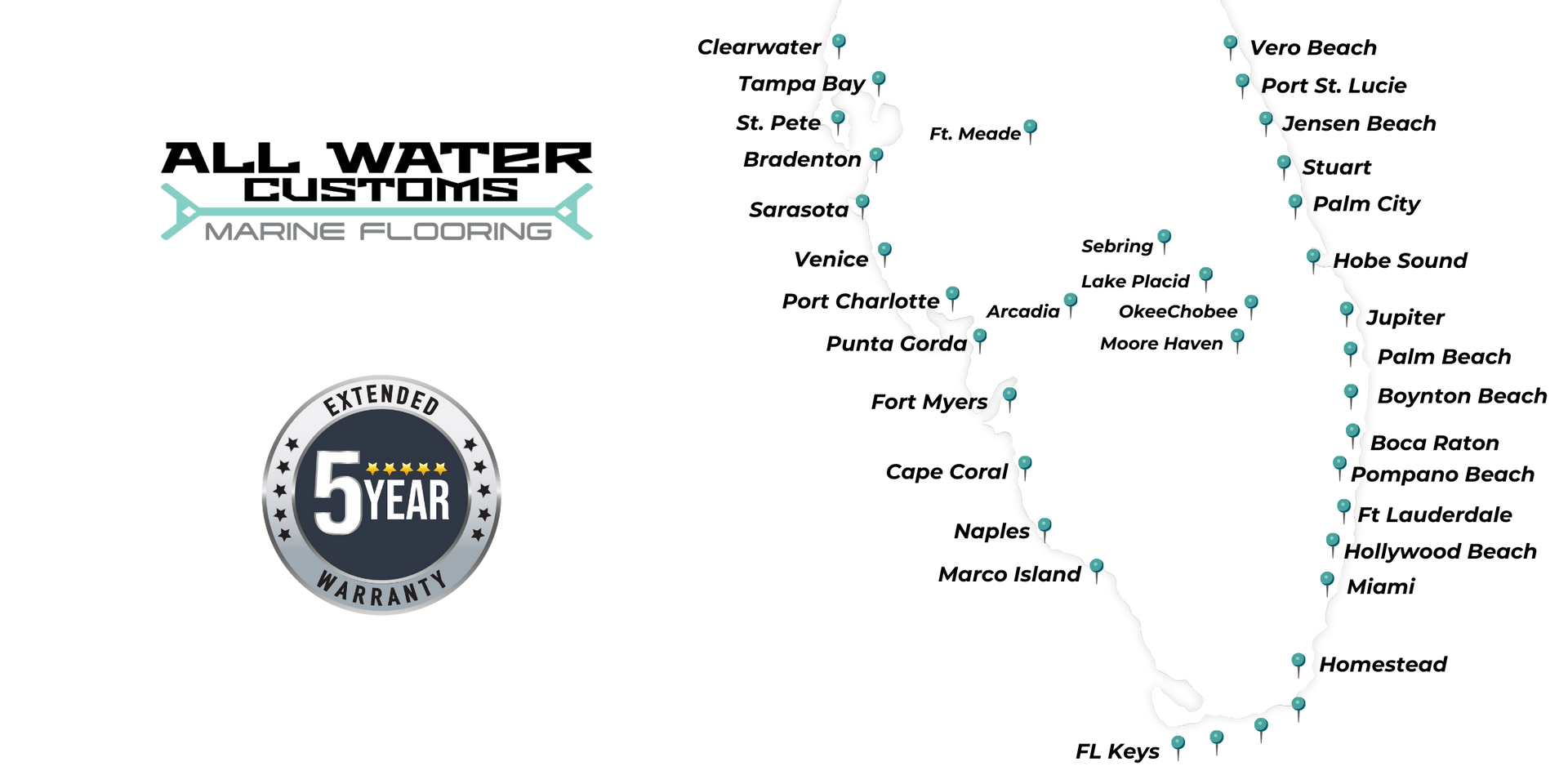
- A real warranty names what it covers; AllWater Customs covers Adhesive and Light Amplification for 5 years in writing, provided before installation.
- The full process from measurement to installation typically runs 3 to 3.5 weeks. If a company offers shorter turnaround times, it probes a question as to what corners they are cutting to get it done so quickly.
Choosing a boat flooring installer in Florida comes down to a handful of specific questions about how they measure, how they cut, what their warranty actually covers, how long they take, and what materials they put under your feet. Most buyers get vague answers to all five and end up guessing. This guide gives you the exact questions to ask so you can compare installers on facts instead of promises. If you want to see how a real process runs start to finish, our page on custom boat flooring in Florida walks through each step.
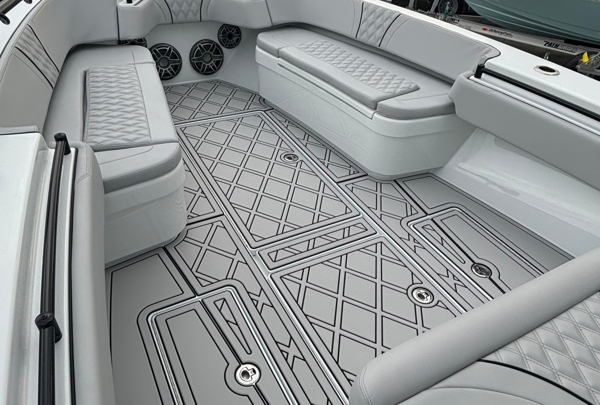
Boat flooring is the non-skid foam decking that replaces slick fiberglass, worn carpet, or cracked vinyl on your boat. Done right, it fits the deck exactly, grips underfoot, stays cool enough to stand on in July, and cleans with a hose. Done wrong, it lifts at the edges, fades in a season, or arrives cut a half-inch off and gets shimmed into place. The difference is almost always in the process, not the sales pitch.
Do they measure with a digitizing tool?
Ask this first. The measurement method sets the ceiling on how well the finished floor can fit, and no amount of skill during install fixes a bad measurement.
A tape measure and a sketch captures rough dimensions. It does not capture the curve of a gunwale, the radius around a console base, or the compound angles where a deck steps down. Those are the exact spots where a poorly measured floor shows gaps or overlaps.
We start with a precision digitizing tool that captures the actual geometry of your deck and converts it into a CAD file. That file is the blueprint the flooring gets cut from, so the pattern matches the boat instead of an approximation of it. When an installer tells you they will "measure it up" with a tape, ask how they handle curves and cutouts. The answer tells you a lot.

Before anything gets fabricated, you should also see the plan. We send an electronic Approval Drawing showing the full layout, color, and pattern for you to sign off on. You are looking at the exact floor before a single piece is cut. If an installer cannot show you what you are buying in advance, you are trusting their memory of the conversation.
Another thing to consider is the adhesion depends on a clean bond, and a clean bond is hard to get while trimming foam in the heat with the boat in a slip. We use a proprietary double adhesive on our non-skid flooring, applied to pieces that were cut precisely enough not to need forcing into position. When a floor is stretched or compressed to fit a bad cut, that stress works against the adhesive every heat cycle. If you want the background on why installs fail down here, our breakdown of why Florida boat flooring fails covers the heat and humidity factors in detail.
BUILDER'S NOTE
The single most common cause of a lifting edge is not bad glue. It is a piece that was cut slightly wrong and installed under tension. Every day the deck heats up and cools down, that tension pulls at the bond line. Precise cutting is not a luxury step – it is the thing that keeps the adhesive doing its one job.
What does their warranty specifically cover
A warranty is only as good as the words in it. "Lifetime warranty" and "we stand behind our work" tell you nothing about what happens when something goes wrong. Ask for the covered items by name, in writing.
Our 5-Year Warranty covers two things: Adhesive and Light Amplification. Adhesive coverage addresses the bond holding the floor to your deck – the failure mode most buyers have seen firsthand. Light Amplification coverage addresses how the material handles sun exposure over time, which in Florida is the difference between a floor that holds its color and one that goes chalky. We are the only company that covers Light Amplification alongside Adhesive.
You receive that warranty in writing before installation, not as a verbal promise or a line on the invoice after the fact. Read it. A warranty that names its covered items and its term is one you can actually hold someone to. A warranty that gestures at "coverage" without specifics is a marketing line.
Be direct with any installer about this. Ask what is covered, for how long, and whether you get it in writing before work starts. If the answer gets vague, that vagueness is your answer.
What is their timeline and why
A realistic timeline is a sign the installer has a defined process. An installer who promises a floor tomorrow is skipping steps, and the steps they skip are usually measurement and approval.
Our typical timeline from measurement to installation is 3 to 3.5 weeks. Here is where that time goes: the digitizing capture, converting it to a CAD file, sending you the Approval Drawing and waiting for your sign-off, CNC-cutting the pieces in the U.S., and scheduling the install. None of those steps is filler. Each one is a checkpoint that keeps the finished floor matching what you approved.
The one part that is fast is the estimate. We offer same-day estimates with no separate pre-quote measurement visit required, and the estimate is free. Ten years of measuring every make and model means we can give you an accurate number without dragging out a multi-visit quoting process. So the front end is quick and the fabrication is deliberate – which is the order you want it in.
If a timeline sounds too short, ask what got cut. If it sounds open-ended with no explanation, ask for the checkpoints. A good installer can tell you what happens in each week.
What materials do they use and how long were they tested
The material under your feet has to survive Florida specifically. Sun, heat cycling, salt, and humidity break down flooring that would last elsewhere, so ask two things: what exactly is the material, and how long has it been in service down here.
Our flooring is 100% Closed-Cell PE foam. Closed-cell means the foam does not absorb water, which matters in salt air and humidity. The colors are heat-infused rather than surface-printed, so they do not bleed. It is 100% non-slip for grip when the deck is wet, and it carries a high heat threshold so it stays comfortable underfoot in direct Florida sun instead of turning into a griddle. It is also 100% stain-resistant and cleans with a rinse.

On the testing question: AllWater Customs was founded in 2016 by Andy Werner, a Naples native with 20 years in high-end construction and boating. That is more than ten years of operation with thousands of installs completed in Florida conditions. The relevant number is not how a material performs in a lab. It is how it performs after years of Gulf sun and summer heat cycles, which is the only test that predicts how yours will hold up.
When an installer names a generic "marine foam" without telling you the cell structure, the color process, or how long it has been on boats in your area, they are asking you to find out the hard way. Make them specific.
The one decision, made once
Waiting on a floor that is already lifting or faded just means another season of standing on it and thinking about it. The point of doing this correctly is that you decide once and stop having to. A floor that was measured with a digitizing tool, cut on a CNC machine to your approved drawing, bonded with double adhesive, and backed by a written 5-Year Warranty on Adhesive and Light Amplification is a floor you are not going to be researching again in two years.
AllWater Customs works best for boat owners who want the whole deck done right rather than a single piece patched cheaply, and the same-day free estimate means you can get an accurate number without committing to anything. Request your free estimate, review the Approval Drawing before a single piece is cut, and get the written warranty in hand before installation starts. That is the sequence that lets you make this one decision and move on.
Frequently Asked Questions
How do you measure my boat deck, and do I need to schedule a separate visit for it?
We capture your deck with a precision digitizing tool that records the actual geometry, including curves, radiuses around console bases, and compound angles where the deck steps down. That capture becomes a CAD file, which is the blueprint your flooring gets cut from, so the pattern matches your boat rather than an approximation of it. You do not need a separate pre-quote measurement visit. We offer same-day estimates at no cost, backed by ten years of measuring every make and model.
What exactly does your warranty cover, and when do I get it?
Our 5-Year Warranty covers two specific things by name: Adhesive and Light Amplification. Adhesive coverage addresses the bond holding the floor to your deck, which is the failure mode most buyers have seen firsthand. Light Amplification coverage addresses how the material handles sun exposure over time, which in Florida is the difference between a floor that holds its color and one that goes chalky. We are the only company that covers Light Amplification alongside Adhesive. You receive the warranty in writing before installation begins, not as a verbal promise or a line added to the invoice afterward.
How long does the whole process take from start to finish?
The typical timeline from measurement to installation runs 3 to 3.5 weeks. That time covers the digitizing capture, converting it to a CAD file, sending you an electronic Approval Drawing showing the full layout, color, and pattern for your sign-off, CNC-cutting the pieces in the U.S. to your exact measurements, and scheduling the install. Each step is a checkpoint that keeps the finished floor matching what you approved. The estimate itself is fast and free, with no separate measurement visit required.
Will the flooring hold up to Florida sun, heat, and salt air?
The material is 100% Closed-Cell PE foam, which does not absorb water, so it handles salt air and humidity. The colors are heat-infused rather than surface-printed, so they do not bleed, and the foam carries a high heat threshold so it stays comfortable underfoot in direct sun instead of turning into a griddle. It is 100% non-slip for grip on a wet deck and 100% stain-resistant, cleaning with a rinse. On the deck itself, we use a proprietary double adhesive on our non-skid flooring, applied to pieces cut precisely enough that they do not need to be forced into position and put stress on the bond during heat cycling. AllWater Customs has operated for more than ten years with thousands of installs completed in Florida conditions.

Susan Werner is a business growth and operations executive with more than 20 years of experience leading sales, marketing, and operational performance initiatives. As VP of Operations at All Water Customs, she oversees revenue growth, digital marketing strategy, customer acquisition, sales infrastructure, business operations, and strategic product development within the marine flooring industry. Susan is recognized for building scalable systems that drive measurable growth while also leading research and development efforts in marine flooring materials, helping introduce higher-performing foam technologies that improve durability, enhance customer satisfaction, and support stronger warranty programs for both boat owners and marine flooring businesses.